Funding & Compliance
FCC Reporting Requirements in 2025: An ISP Compliance Guide
A concise guide to key FCC reporting requirements in 2025 - including DIRS, BDC, HUBB, PSAP, ETRS, and more - plus compliance steps and timelines.
Taneil Currie, Former Senior Manager, Growth Marketing
August 21, 2025 · 4 MIN · UPD JUN 16, 2026
For ISPs, 2025 FCC reporting spans several filings due throughout the year: DIRS for declared emergencies, BDC twice annually, HUBB for high-cost support recipients, PSAP notifications within 30 minutes of a 911 outage, ETRS Form One by October 3, and Forms 499-A and 499-Q for revenue. This guide outlines each requirement, what it entails, and where to find official FCC resources.
FCC reporting can be complex. With multiple filings due throughout the year and updates to key programs, broadband providers need a clear, reliable way to stay compliant. The sections below break down the major 2025 reporting requirements for ISPs and link to the official FCC guidance for each one.
DIRS: Disaster Information Reporting System
As of February 20, 2025, reporting to the Disaster Information Reporting System (DIRS) is mandatory for telecommunications, broadband, and VoIP providers during FCC-declared emergencies.
If the FCC activates DIRS during a natural disaster, cyberattack, or other qualifying event, providers are required to submit outage information, infrastructure status, and restoration updates.
More information:
FCC Public Notice DA-25-74A1
DIRS Overview - FCC
BDC: Broadband Data Collection
The Broadband Data Collection (BDC) program requires providers to submit detailed broadband availability data twice each year:
March 1 (for data as of December 31 of the previous year)
September 1 (for data as of June 30)
Filings must use the FCC's Broadband Serviceable Location Fabric, which maps out valid serviceable locations. Data must be accurate and reflect where service is offered or can be provided within 10 business days.
More information:
FCC BDC Filing Page
FCC Location Fabric Overview
HUBB: High-Cost Universal Broadband Portal
If your company receives federal support through programs like A-CAM, you must report broadband deployment activity using the HUBB system.
For 2025, the HUBB deadline to report deployment data for the prior calendar year was March 3.
Looking ahead, the FCC is transitioning HUBB reporting to use Location Fabric IDs instead of latitude and longitude coordinates. This change will become mandatory starting with the March 2, 2026 deadline.
More information:
FCC HUBB Transition Notice
FCC HUBB Reporting Portal
PSAP Notifications: 911 Outage Alerts
If your network experiences an outage that affects 911 service, FCC rules require you to notify the appropriate Public Safety Answering Points (PSAPs) within 30 minutes of identifying the issue. This rule applies to any outage that potentially impacts the ability of customers to reach emergency services.
You must also provide follow-up notifications as updates become available. Contact information for PSAPs should be kept current.
More information:
FCC PSAP Outage Notification Rules
ETRS: Emergency Alert System Reporting
While FEMA is not conducting a nationwide Emergency Alert System (EAS) test in 2025, the FCC still requires service providers to file ETRS Form One by October 3, 2025.
This form verifies that your systems are registered and compliant with national alerting requirements.
More information:
FCC EAS Test Reporting System (ETRS)
FCC Forms 499-A and 499-Q: Telecom Revenue Reporting
Telecommunications providers are required to report revenue through:
Form 499-A (filed annually)
Form 499-Q (filed quarterly)
These forms are used to calculate contributions to the Universal Service Fund (). The FCC publishes updated instructions and deadlines each year.
More information:
FCC 499 Filing Resources
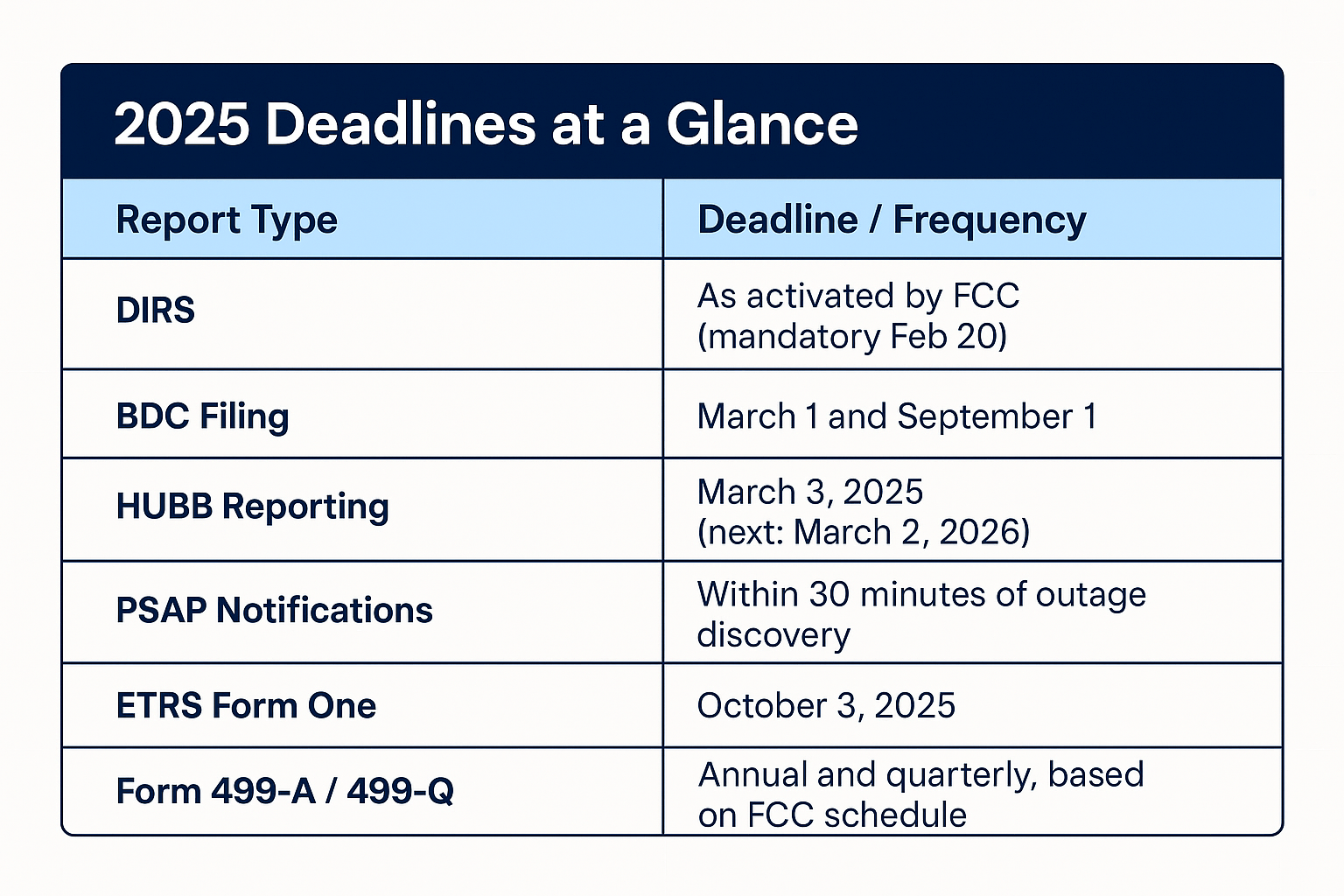
2025 FCC Reporting Deadlines at a Glance
Compliance Tips for ISP Teams
Track deadlines early. Map out key submission dates and assign responsibilities within your team.
Use the Location Fabric. This data set is now essential for both BDC and HUBB filings.
Review your 911 processes. Confirm you can meet the 30-minute PSAP notification requirement.
Stay informed. Subscribe to FCC public notices or updates related to broadband and reporting changes.
Test your portals. Log into HUBB, BDC, ETRS, and 499 systems ahead of time to avoid last-minute issues.
Accurate, current network and subscriber data is the foundation of every one of these filings, and an /BSS platform like Sonar Software keeps that record of service availability and infrastructure in one place so reporting season is less of a scramble.
Final Thoughts
FCC reporting in 2025 may feel like a lot, but with clear deadlines, the right tools, and a bit of prep, it's totally manageable. Staying on top of these requirements not only keeps you compliant but also builds trust with your customers, communities, and regulators.
Frequently asked questions
When did DIRS reporting become mandatory for providers?
As of February 20, 2025, DIRS reporting is mandatory for telecommunications, broadband, and VoIP providers during FCC-declared emergencies, covering outage information, infrastructure status, and restoration updates.
What are the 2025 BDC filing deadlines?
BDC availability data is filed twice a year: by March 1 (data as of December 31 of the prior year) and by September 1 (data as of June 30), using the FCC Broadband Serviceable Location Fabric.
How fast must ISPs notify PSAPs of a 911 outage?
Providers must notify the appropriate PSAPs within 30 minutes of identifying any outage that could affect customers' ability to reach emergency services, followed by updates as they become available.
Questions, answered.
When is DIRS reporting mandatory for broadband and VoIP providers?
As of February 20, 2025, DIRS reporting is mandatory for telecommunications, broadband, and VoIP providers during FCC-declared emergencies.
What are the 2025 BDC filing deadlines and what data is required?
Broadband Data Collection filings are due twice a year, on March 1 and September 1. Filings use the FCC Broadband Serviceable Location Fabric.
How quickly must providers notify PSAPs after a 911-affecting outage?
Providers must notify the appropriate PSAPs within 30 minutes of identifying any outage that affects 911 service.
What is changing with HUBB reporting and when does it take effect?
HUBB reporting transitions from latitude and longitude to Location Fabric IDs. The change becomes mandatory starting with the March 2, 2026 deadline.
See it on the platform
20 minutes wired to your operation.
An ISP-only specialist walks Sonar through your specific use case. No generic deck, no horizontal SaaS pitch.
Book a meeting