Sonar 2026 · ISP Terminology
GLOSSARY
The language of broadband operations.
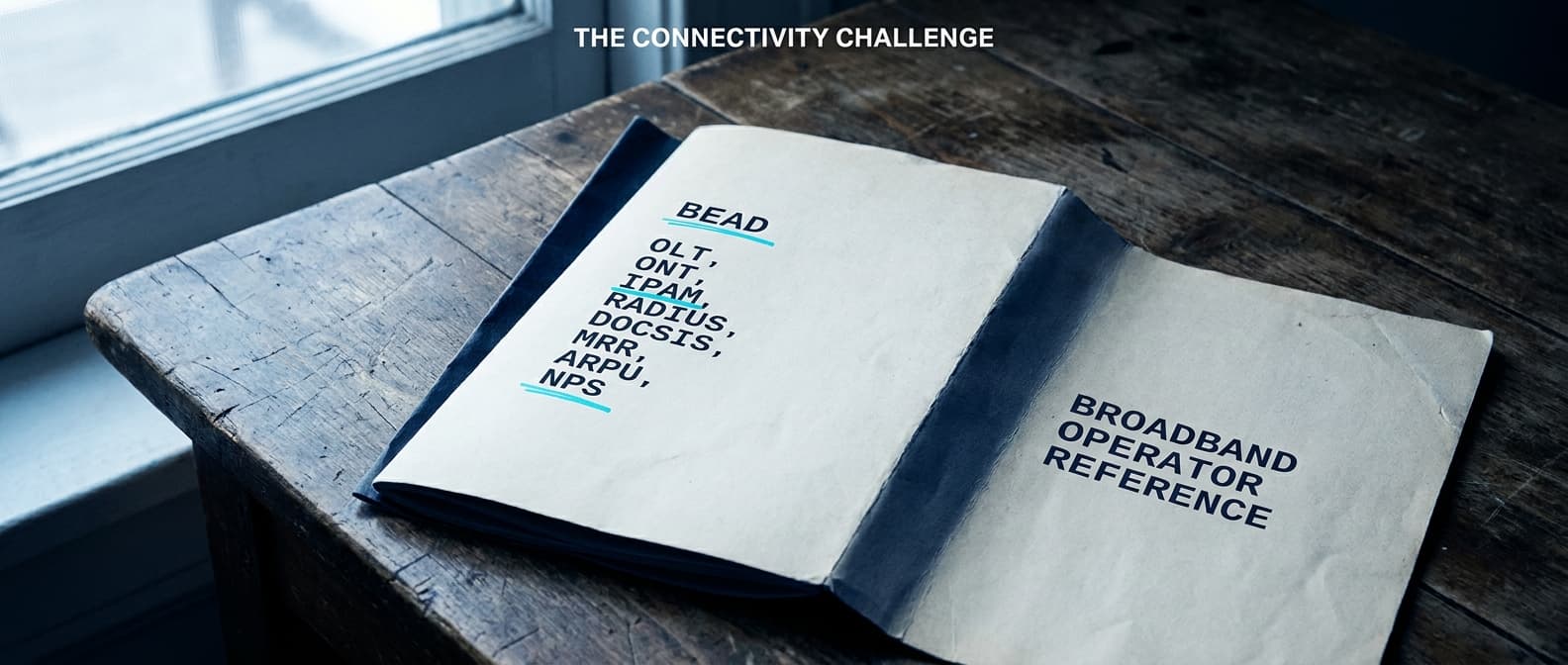
BEAD, IPAM, OLT, ONT, DOCSIS, MRR, churn. Defined the way operators actually use them.
32Terms
Funding & Compliance
- BEAD(Broadband Equity, Access, and Deployment)
- $42.5 billion federal program administered by the NTIA to fund high-speed internet deployment in underserved areas. Sub-grantees report on deployment progress for six years.
- FCC BDC(FCC Broadband Data Collection)
- FCC program requiring providers to file broadband availability data twice yearly. Data feeds the National Broadband Map and informs funding eligibility.
- CAF(Connect America Fund)
- FCC subsidy program supporting broadband deployment in high-cost rural areas. Largely succeeded by BEAD and the Rural Digital Opportunity Fund (RDOF).
- Broadband Label
- FCC-mandated nutrition-style label that ISPs must display at point of sale, listing speeds, prices, fees, data caps, and network management practices.
- USF(Universal Service Fund)
- Federal fund that supports telecommunications service in rural, low-income, and high-cost areas. Funded by fees on telecom carriers passed through to subscribers.
- E911
- Enhanced 911 service that delivers automatic location information to emergency responders. Mandated for VoIP providers via per-line fees.
Related: BEAD, Broadband Label
Related: FCC BDC
Network & Hardware
- IPAM(IP Address Management)
- System for tracking and assigning IP addresses across a network. Prevents address collisions, tracks which IPs are assigned to which subscribers, and provides the audit trail BEAD compliance needs.
- OLT(Optical Line Terminal)
- Headend device in a passive optical network (PON) that connects fiber subscribers to the operator's network. Talks to ONTs at the customer premise.
- ONT(Optical Network Terminal)
- Customer-premise device that terminates the fiber connection and delivers Ethernet, voice, or video to the subscriber. The fiber equivalent of a cable modem.
- DOCSIS(Data Over Cable Service Interface Specification)
- International standard for delivering high-speed internet over cable TV infrastructure. DOCSIS 3.1 supports gigabit speeds; DOCSIS 4.0 supports multi-gig symmetrical.
- RADIUS(Remote Authentication Dial-In User Service)
- Networking protocol that authenticates and authorizes subscribers connecting to an ISP. Commonly paired with FreeRADIUS for ISP deployments.
- DHCP(Dynamic Host Configuration Protocol)
- Network protocol that assigns IP addresses and configuration to devices automatically. ISPs use DHCP to provision subscriber gear without manual setup.
- FTTH(Fiber to the Home)
- Network architecture that runs fiber optic cable directly to each subscriber's residence, delivering the highest available speeds.
- FTTN(Fiber to the Node)
- Hybrid architecture where fiber runs to a neighborhood node and copper completes the last leg. Lower cost than FTTH but capped on speed.
- WISP(Wireless Internet Service Provider)
- Operator delivering internet via fixed wireless from towers to fixed antennas at subscriber premises. Common in rural areas where fiber is uneconomic.
- MDU(Multi-Dwelling Unit)
- Apartment building, condo, or other property with multiple residential units sharing infrastructure. ISPs serving MDUs bill the property and/or individual residents.
- CGNAT(Carrier-Grade NAT)
- Network address translation at carrier scale, sharing public IPv4 addresses across many subscribers. Used to extend IPv4 capacity during the IPv6 transition.
Related: FTTH
Related: IPAM
Internet Standards
- VLAN(Virtual Local Area Network)
- Logical separation of a physical network into isolated virtual segments. ISPs use VLANs to separate customer traffic, management traffic, and services.
- QoS(Quality of Service)
- Traffic management techniques that prioritize specific traffic types over others. Voice and video calls typically get QoS preference over bulk downloads.
- QoE(Quality of Experience)
- End-user perception of network performance. QoE complements QoS by measuring the experience subscribers actually have, not just protocol-level metrics.
Operations
- OSS(Operations Support Systems)
- Software that handles network operations: provisioning, monitoring, dispatch, inventory. The technical backbone of ISP operations.
- BSS(Business Support Systems)
- Software that handles business operations: billing, customer management, ticketing, communications. The commercial side of ISP operations.
- Truck Roll
- Dispatching a technician to a customer site for installation, repair, or equipment swap. Each truck roll costs $50–$200 in labor and time.
Related: BSS
Related: OSS
Customer & Billing
- MRR(Monthly Recurring Revenue)
- Predictable monthly revenue from active subscribers. The primary metric ISPs report to lenders, PE firms, and BEAD reviewers.
- ARPU(Average Revenue Per User)
- MRR divided by active subscriber count. Tracks pricing power and plan mix over time.
- Churn
- Rate at which subscribers cancel service over a period. Churn directly impacts MRR and the unit economics of ISP operations.
- NPS(Net Promoter Score)
- Customer loyalty metric calculated from a 0–10 likelihood-to-recommend question. NPS above 30 is generally considered good for ISPs.
- CSAT(Customer Satisfaction Score)
- Customer experience metric derived from post-interaction surveys. Often paired with NPS for retention analysis.
- Dunning
- Process of communicating with customers about overdue payments, including reminders, grace periods, and eventual service suspension.
- Proration
- Adjusting bills for partial billing periods when service starts, stops, or changes mid-cycle. Critical for accurate revenue recognition.
- Vacation Mode
- Billing feature that pauses service charges for subscribers who temporarily don't need service (seasonal homes, deployments, etc.) without losing the account.
Related: MRR
Related: NPS
Want to see the platform?
Sonar runs on the language operators speak.
Built for ISPs since 2015. Every term in this glossary maps to something the platform handles.
Book a meeting