Security
4 Cyber Security Tips for Internet Service Providers
Four practical cyber security tips every ISP should have in place, from DDoS defense to DNS hardening.
June 1, 2024 · 1 MIN · UPD SEP 2, 2026
Security is foundational for an internet service provider. These four practical tips help ISPs protect their network, their team, and their subscribers.
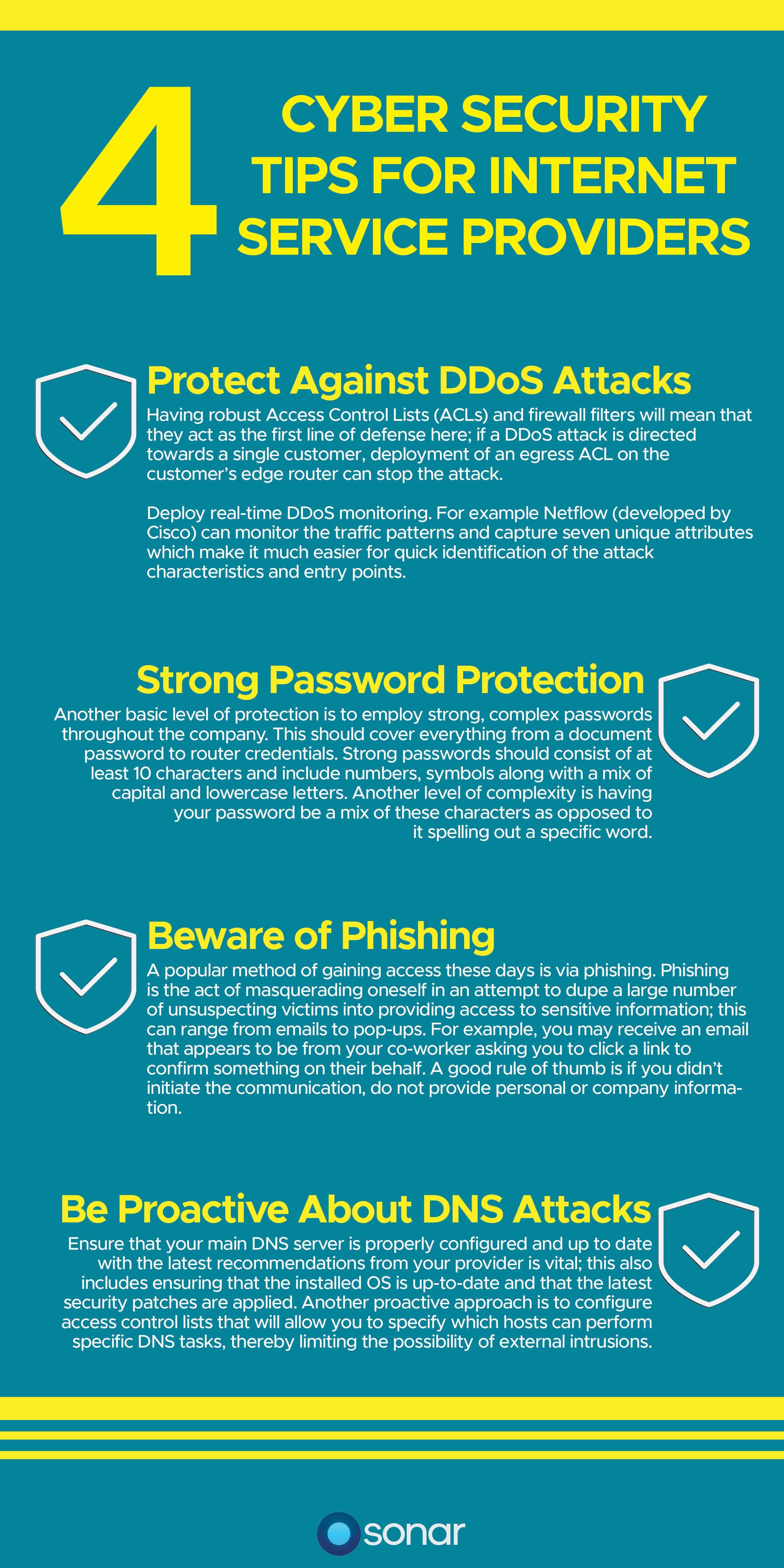
Protect against DDoS attacks
Robust Access Control Lists (ACLs) and firewall filters are your first line of defense. If a DDoS attack is directed at a customer, deploying an egress ACL on the customer’s edge router can stop the attack. Use real-time DDoS monitoring, for example NetFlow, to monitor traffic patterns and capture the attack’s characteristics and entry points.
Enforce strong password protection
A basic but essential layer of protection is strong, complex passwords. Require at least 10 characters with a mix of capitals, lowercase letters, numbers, and symbols, and never a single dictionary word. The more complex the password, the harder it is to crack.
Train your team to spot phishing
Phishing attacks grow more sophisticated every day. They masquerade as a trusted source to trick someone into handing over sensitive information. Confirm requests through a known channel before acting, do not click links from unknown senders, and never provide personal or company information unless you have verified the request.
Be proactive about DNS attacks
Make sure your main DNS server is properly configured and patched, follow the security recommendations from your provider, and keep your operating system up to date. A proactive approach to DNS access control limits the possibility of external intrusions.
Questions, answered.
How can an ISP defend against DDoS attacks?
An egress ACL on the customer edge router can stop a DDoS directed at that customer, filtering the malicious traffic before it overwhelms the connection.
What are basic cyber security best practices for ISPs?
Enforce strong passwords (at least 10 characters with mixed case, numbers, and symbols, and no dictionary words), keep DNS servers patched and properly configured, and apply egress filtering on customer edge routers.
How do ISPs prevent phishing and DNS attacks?
A patched, properly configured DNS server limits external intrusions, and training staff to recognize phishing reduces the risk of credential theft that opens the door to those attacks.
See it on the platform
20 minutes wired to your operation.
An ISP-only specialist walks Sonar through your specific use case. No generic deck, no horizontal SaaS pitch.
Book a meeting