Industry insight
Fiber Resurgence 2025: What ISPs Need to Know About BEAD, Hybrid Networks, and Operations
Explore the shift from wireless to fiber and what 2025 means for ISPs. Learn hybrid strategies, funding advice, and operational best practices.
September 17, 2025 · 5 MIN · UPD JUN 16, 2026
Fiber is the 2025 mandate for ISPs: with $42 billion in funding reaching states, the providers who win will pair fiber and fixed wireless in hybrid networks and unify their operations on a single OSS/BSS platform. Here is what that shift means for your next phase of growth.
If 2024 was marked by hesitation, 2025 is shaping up to be the year fiber moves from momentum to mandate. While the broadband industry saw record fiber builds last year, uncertainty in funding, policy, and deployment models left many operators in a holding pattern. That has now changed.
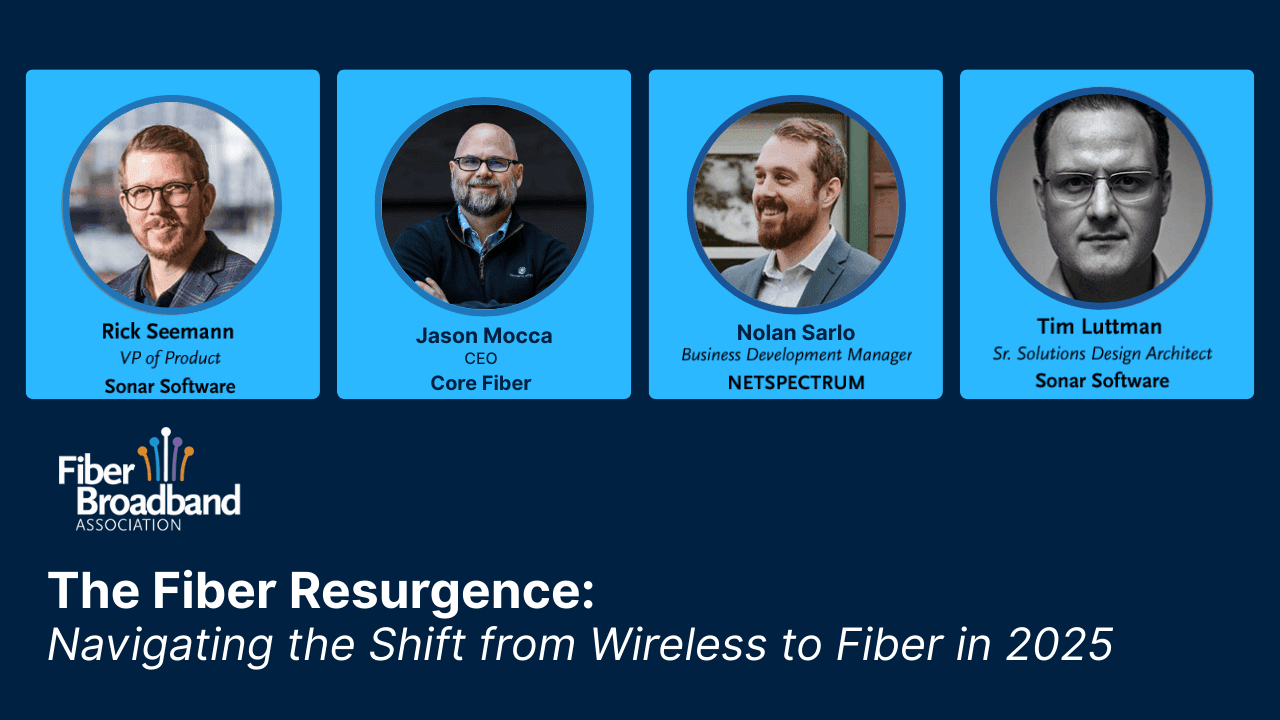
In a recent webinar hosted by the Fiber Broadband Association, a panel of experienced industry leaders discussed the operational, financial, and strategic realities behind the shift from wireless to fiber. This conversation, centered around lessons from the field, funding trends, and hybrid models, offered a clear-eyed view of how ISPs can lead through transformation.
🎥 Watch the Webinar Replay 👇
Here are the key takeaways from that session and what they mean for internet service providers planning their next phase of growth.
Fiber's Return Is a Mandate, Not Just Hype
Despite policy delays, fiber has re-emerged as the infrastructure of choice for long-term performance, community development, and public investment. With $42 billion in BEAD funding now reaching states, and with large carriers committing to multi-million line expansions, fiber is not just back. It is being prioritized across urban and rural markets.
Panelist Jason Boca, CEO of Core Fiber Partners, put it plainly: fiber is not just a speed upgrade, it is an equalizer that unlocks access to education, health, work, and innovation. For communities historically underserved or overlooked, fiber represents relief and inclusion.
Hybrid Fiber and Fixed Wireless Networks Are the Practical Future
While fiber offers unmatched long-term benefits, fixed wireless access still plays a vital role in network strategies, particularly where geography, terrain, or capex constraints require faster time-to-serve. Rural and regional ISPs are increasingly blending technologies to strike the right balance between reach and resilience.
The hybrid model is proving effective. Wireless is used to extend coverage quickly, especially in challenging environments, while fiber is deployed where density, economics, and long-term value align. Operators who adopt this dual-track approach gain flexibility without compromising their growth trajectory.
ISP Operations Must Evolve to Match the Infrastructure
Making the move from wireless-first operations to a fiber-led model is more than a shift in physical plant. It is an organizational reset. Many ISPs are discovering that while fiber is technically superior, it brings new workflows, terminology, training needs, and customer expectations.
Panelist Nolan Sarlo of Net Spectrum shared that transitioning to fiber required his entire front-line team to relearn installation flows, support practices, and communication protocols. The transition revealed a clear operational gap that had to be addressed in order to deliver a high-quality customer experience. Teams that once operated smoothly in a wireless environment found themselves navigating unfamiliar processes, tools, and expectations.
This challenge is compounded when tools are fragmented. Without integrated systems, teams are forced to toggle between vendor portals, resulting in inefficiencies that impact service delivery and profitability.
BEAD Funding Is a Trust Game, Not a Speed Game
While funding programs like BEAD have created unprecedented opportunities for infrastructure investment, access to capital is only part of the equation. The panel emphasized that successful applicants are those who show up prepared. This means having shovel-ready engineering, established relationships with local governments, and the ability to deliver on what is proposed.
It also means knowing which grants to walk away from. Not every opportunity is worth the resources or risk. Pursuing every available dollar without a clear delivery strategy can backfire. Funders and communities alike are looking for credibility, not just ambition.
Technology Choices Should Be Built to Scale
One recurring theme throughout the webinar was the importance of future-proofing. The core asset in any fiber deployment is the physical infrastructure. Equipment will change, but the fiber must be built to last. Choosing tools or vendors based on short-term cost savings often leads to long-term limitations.
Panelist Tim Luttman of Sonar Software explained that interoperability across systems and vendor tools is no longer a luxury. It is a requirement. ISPs must avoid "swivel-chair ops" - where staff toggle between siloed systems - and instead pursue platforms that offer a unified operational view.
A single pane of glass approach, where billing, inventory, dispatch, and customer service are centralized, reduces errors, accelerates time-to-resolution, and improves customer satisfaction. It also ensures the business can scale without needing to constantly re-architect its processes.
What This Means for ISPs
The message from the webinar was clear. Fiber is accelerating, but success will depend on more than deployment schedules and grant awards. ISPs must align their technology, operations, and partnerships around a future that prioritizes efficiency, reliability, and community value.
The winners in this next phase will be the providers who invest not just in fiber, but in the systems, people, and processes that turn fiber into real-world outcomes. That includes empowering teams with better tools, engaging stakeholders with confidence, and maintaining the operational discipline needed to deliver excellent service at scale.
How Sonar Software Supports Fiber-First Providers
Sonar is purpose-built to help ISPs navigate this transition. Whether operating a hybrid network or going all-in on fiber, Sonar enables service providers to streamline and scale through automation, visibility, and integration.
Our platform includes:
Unified billing, inventory, dispatch, and network monitoring
Customer portals that reduce support volume and improve satisfaction
Reporting for funding, compliance, and performance
Scalable architecture that grows with your network and customer base
Sonar helps you simplify operations, improve service delivery, and prepare for what's next.
If you applied for BEAD funding or planning a new fiber build, start with our **BEAD Funding Toolkit.**
Frequently asked questions
Why is fiber resurging for ISPs in 2025?
After a year of hesitation driven by uncertainty in funding, policy, and deployment models, fiber has re-emerged as the infrastructure of choice for long-term performance and public investment. With $42 billion in BEAD funding reaching states and large carriers committing to multi-million line expansions, fiber is being prioritized across both urban and rural markets.
Should ISPs choose fiber or fixed wireless?
For many rural and regional ISPs the answer is both. A hybrid model uses fixed wireless access to extend coverage quickly where geography, terrain, or capex constraints demand faster time-to-serve, while fiber is deployed where density, economics, and long-term value align.
What makes a BEAD funding application succeed?
Successful applicants show up prepared with shovel-ready engineering, established relationships with local governments, and the ability to deliver on what they propose. It also means knowing which grants to walk away from, since funders are looking for credibility, not just ambition.
Questions, answered.
Why is fiber resurging for ISPs in 2025?
In 2025 fiber moves from momentum to mandate. With $42 billion in BEAD funding reaching states and large carriers committing to multi-million line expansions, the industry is shifting from wireless toward fiber.
How does BEAD funding affect ISP fiber deployment?
BEAD is directing $42 billion to states to support broadband expansion, which is accelerating fiber buildouts. Successful applicants show up prepared with shovel-ready engineering and local-government relationships, and they know which grants to walk away from.
When should ISPs use hybrid fixed wireless and fiber networks?
Hybrid networks that pair fixed wireless access for fast time-to-serve with fiber for density and long-term value are the practical future for rural and regional ISPs. This approach lets operators reach subscribers quickly while building fiber where it delivers lasting value.
What operational changes do ISPs face when moving from wireless to fiber?
Moving from wireless-first to fiber-led operations is an organizational reset that demands new workflows, training, and customer-experience practices, not just new physical plant. Fiber infrastructure must also be built to last, so technology and vendor choices should be made to scale rather than for short-term cost savings.
See it on the platform
20 minutes wired to your operation.
An ISP-only specialist walks Sonar through your specific use case. No generic deck, no horizontal SaaS pitch.
Book a meeting