Building Better Broadband Starts With Building Better Partnerships
Building better broadband requires strong partnerships. Learn from Curtis Dean of C-BAN on the importance of collaboration and community connection in...
October 28, 2025 · 50:23 listen
Watch this episode
Watch it here, or listen in your app of choice.
Show notes
In broadband, we like to say we’re connecting communities—but what does that really mean if we’re not also connecting to each other? That was the core of our conversation on the latest episode of Bandwidth, where we sat down with Curtis Dean from the Community Broadband Action Network (C-BAN) to talk about the real work behind local partnerships—and the stakes when we get it wrong.
For those unfamiliar with C-BAN, they’re a nonprofit built around one powerful idea: when providers, advocates, and communities talk to each other, good things happen. And Curtis? He’s basically the human Rolodex of broadband collaboration. (Though my son thinks a Rolodex is a “row of ducks,” which honestly, same energy.)
Partnerships aren’t just nice to have. They’re survival.
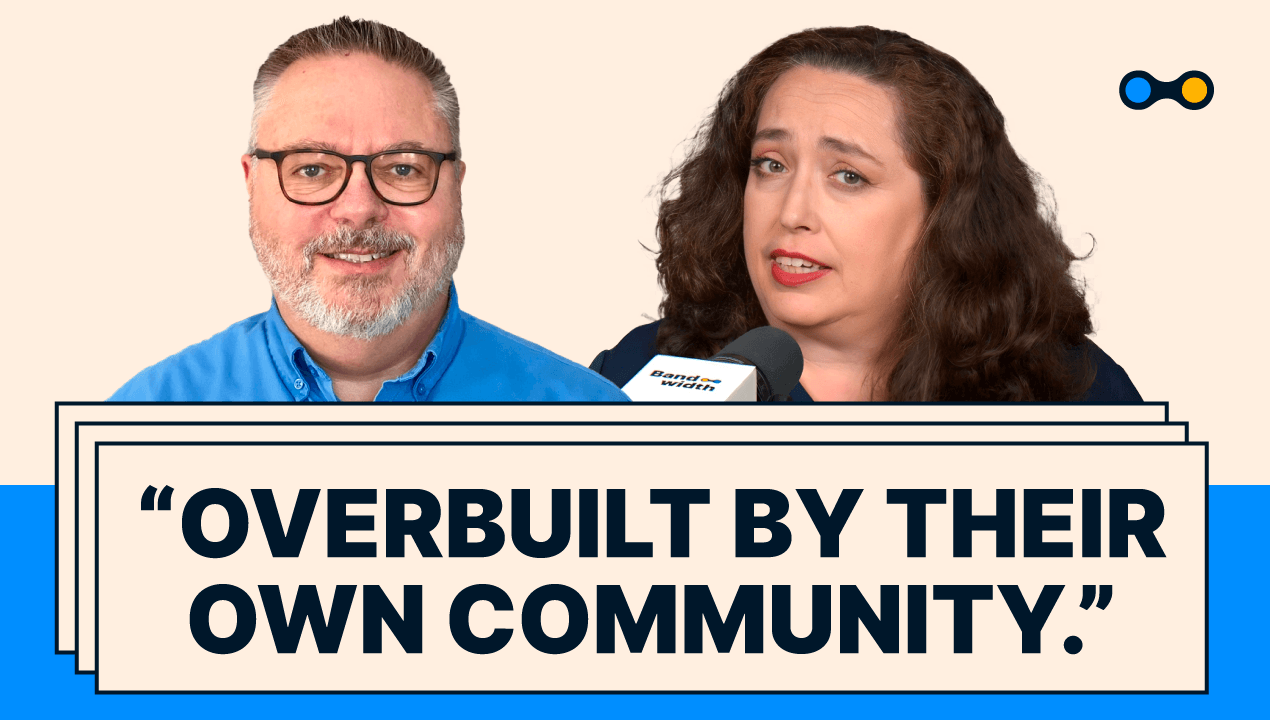
In broadband, it’s not about if something goes wrong—it’s when. Floods, fires, fiber cuts, cyberattacks—they don’t discriminate. And when those moments hit, providers who’ve built strong relationships are the ones who bounce back fastest. But let’s not romanticize it. Partnership isn’t always instinctual—especially in a world where competitive lines are tightly drawn. As Curtis shared, even some community-owned networks have suffered because their leaders refused to engage or collaborate. The result? The very communities they were built to serve invited competitors in. That’s not a failure of infrastructure. That’s a failure of relationship.
Be present before the crisis. Be useful before the ask.
One of the best pieces of advice from Curtis: Don’t start partnerships with a pitch. Start by showing up. That means attending city council meetings. Asking for coffee with a local official—not to sell, but to listen. It means knowing the names of public works directors and broadband champions before there’s a grant on the table or a pole attachment in question. As he put it: “Be present.” Presence leads to trust. Trust leads to collaboration. Collaboration leads to better networks.
We talked a lot about how hard it is to collaborate when nobody’s clear on what the actual issue is. ISPs are full of smart people who like to fix things—but if we skip the step of defining the problem together, we end up building ladders to nowhere. That’s where organizations like C-BAN can act as neutral third parties—people who don’t live in the community, don’t profit from the solution, and can hold space for honest conversation. And I don’t just mean technical conversations—I mean hard ones. Who’s at fault? Who’s been holding out? Where did trust break down? You don’t get those answers without relationships. You don’t get those relationships without showing up.
Sometimes the best thing you can do is step aside.
One of my favorite moments from the episode was Curtis’ story about the small-town IT guy who tried to solve his community’s broadband problems himself. He started building a fiber network—out of pocket—only to run out of cash mid-project. It could’ve been a disaster. But because he had connections (and humility), he reached out. Curtis helped connect him with two C-BAN members: one who could buy the network, and another who could operate it. The result? His community gets the broadband they need, and he doesn’t lose everything. It was a reminder that just because you can do something, doesn’t mean you should do it alone.
This applies to more than partnerships. We talked about customer communication, too—especially when things go sideways. If there’s an outage or failure and you go silent, customers fill in the blanks. And those blanks often look a lot worse than reality. Be honest. Be early. Own the bad news and show the plan to fix it. That’s how you build loyalty. Not with speed tests and price wars—but with humanity.
If I had to sum up the whole episode in one line, it would be this: You’re not weak for needing help. You’re smart for knowing when to ask. Broadband is changing fast. Funding is messy. Standards are shifting. And the margin for error is getting thinner every year. We need each other—whether it’s your neighboring ISP, a local official, or a neutral facilitator who can help everyone get aligned. As Curtis said, we need to stop thinking of each other as threats and start seeing each other as allies. We don’t all have to solve the same problems. But we do have to solve them together.
Catch my full conversation on the Bandwidth podcast. Available now on Spotify , Apple Podcasts , and the Bandwidth YouTube Channel .